Posts mit dem Label ECHR werden angezeigt. Alle Posts anzeigen

9/28/2019

Who of these unelected pompous blokes looks the most ridiculous?

This question literally tormented me when I heard about the decision of the UK Supreme Court on PM Boris Johnson's suspension of parliament. This, based on my totally biased conviction that anything, literally anything, has to be done to get out of the fucking EU. Away from ze Germans and Merkel which is the EU.

Suspending parliament is one of the lamest options. After all, it is a place of vacuous talk. Well, let them talk at home in the kitchen if they wish so, over popcorn on the couch ...

So here is the crew of the UK.

UK Supremo Court
That is hard to beat. John Galliano came to my mind, but who am I to judge? This UK blogger knows them better. So let's listen in.


Here is a take on their decision before it was taken by a UK professor of law Richard Ekins, and here after their decision.

Who else is competing? Oh yes, Naziland, oops, ze Federal Republic of Teutonia and its Bundesverarschungsgericht in Karlsruhe.

Ze German Constitutional Court

Crikey, we've seen that color before. Roland??? Still around? Just kidding. Chief of staff Andy Kotzvuhle is fourth from left. Ready for a oneliner from Andy? Here goes:

"Es gehört zum Selbstverständnis und zur Dignität vieler herausragender Juristen, 
sich nicht selbst anpreisen zu müssen."

Obviously, Andy is not referring to himself, he is just one pompous and fucking conceited dude. Part of it can certainly be blamed on those ridiculously tacky red robes.

Here now the upper echelon of jurisdiction, the European Court of Human Rights, aka the Euro Clowns, in Strasbourg with its often played card of 'Margin of Appreciation' and those totally democratic Single-judge Decisions.

The ECHR crew
The jury is out and, boy, it is tough. Unelected they are all.

These gentlemen run out of the competition.

9/09/2019

Chancellor Merkel, your German ECHR Registrar Westerdiek took care that your criminal civil servant Jürgen Sonneck alias 'C. Paucher' will not tarnish the image of your country


8/06/2019

7/07/2019

Euro Clowns', aka European Court of Human Rights, German Registrar Claudia Westerdiek reliable protector of criminal German civil servant Jürgen Sonneck. Puts paid to Nemo judex

German Registrar Claudia Westerdiek
& Euro Clown judge Potocki
keeping Germany's image squeaky clean.
F A X

European Court of Human Rights
German Registrar Claudia Westerdiek


cc Chancellory Berlin, Federal Ministry of Justice and Consumer Protection, BMAS

Case 51482/18 (Single-Judge decision) - German criminal civil servant Jürgen Sonneck who operated under the false name “C. Paucher” protected by German ECHR Section V.

July 7, 2019

Dear German Registrar Westerdiek,

In ‘Of Publicity’ Jeremy Bentham insisted "Without publicity, no good is permanent; under the auspices of publicity, no evil can continue.” In the same vein John Stuart Mill wrote in ‘Thoughts on Parliamentary Reform’: ’The moral sentiment of mankind, in all periods of tolerably enlightened morality, has condemned concealment’.

You at the ECHR German Section V, aka The German Connection (1), seem to subscribe to Cardinal Richelieu instead: “Secrecy is the first essential in affairs of state” when the image of Germany is at stake and a full blown idiot. The principle of Nemo judex in causa sua leaves you Germans blasé. In addition, the ECHR has the means: Single-Judge decisions, a means of ominous concealment.

In her book ‘Epistemic injustice: Power and the Ethics of Knowing’ Fricker defines two kinds of epistemic injustice: testimonial injustice and hermeneutical injustice. Your Court’s Single-Judge decision belongs to the realm of testimonial injustice which occurs when someone's knowledge is ignored or not believed because that person is the member of a particular social group.

As Economist Bernard Connolly observed: “The European Union is explicitly anti-democratic. It aims at eliminating the rule of law ... It increasingly is Angela Merkel”. One can only shudder reading about ‘Rule 18A2 – Non-judicial rapporteurs’ in Dinah Shelton’s (US professor of International Law Emeritus) "Significantly Disadvantaged? Shrinking Access to the European Court of Human Rights”:
“… the Registry is partly staffed with temporarily seconded personnel paid for by individual states …”
Coincidentally, you are German! “Nachtigall, ick hör dir trapsen” is a German saying. It gets even more scary in "Access to justice in the European Convention on Human Rights system" by Gerards and Glas from the University Utrecht:
“… non-judicial rapporteurs (Registry officers) sift through, assess and categorise the many incoming applications. … these are presented with lists containing single-sentence descriptions of each case. … Relying on the quality of these preparatory documents, the judges usually simply rubber-stamp them, without looking into the file”.
With the Single-Judge decision 51482/18 YOU protected and covered the primitive German criminal civil servant Jürgen Sonneck (from Munich) who had the ass-hatted idea to email a criminal complaint to police using the false name “C. Paucher”, accusing me falsely of hate speech! That amounts to malicious intent.

The blazing stupidity of this criminal creep cum Nazi-style civil servant Jürgen Sonneck was just so embarrassing for Germany, it had to be hidden in the Fritzl Keller of ECHR Single-Judge decisions and, this being "The rotten Heart of Europe" (Bernhard Connolly again),  the ECHR which claims to honor and guarantee human rights in the hodgepodge that is Europe, covers its tracks and resorts to the destruction of the case files:
“The Court shall not keep the file in its archives for more than one year from the date of this decision”.
The ECHR should have the decency to call Single-Judge decisions what they are: a Registry rapporteur decision signed by a single judge who has not even looked at the case file in toto, “seconded by personnel paid for by individual states” who try their best to keep their country’s image clean. In particular, when the EU paymaster’s and high-reputation country Germany’s image needs to be preserved!

In ‘The Impartiality of International Judges: Evidence from the European Court of Human Rights’  Erik Voeten, Georgetown University, informs:
"Admissibility decisions are based on the recommendation of a rapporteur, which is usually the national judge of the respondent government, granting that judge considerable leverage over national cases.”
Shai Dothan addresses in ‘The Motivations of Individual Judges and How They Act as a Group’ the country-specific partialities and bias of the ECHR:
Importantly for the purposes of this paper, international courts are also advised to treat different states differently. States that enjoy a high-reputation for compliance with international law pose a greater threat to the court. Their non-compliance or even their criticism can significantly harm the court's reputation. To counter this threat, international courts treat high-reputation states more leniently than they do low-reputation states. They will reserve their most demanding judgments—especially those that are based on doctrinal novelties—to states that have a low-reputation.
This is seconded by Dinah Shelton who again in ‘Significantly Disadvantaged?’ observes:
“As states do not like to be found in violation of their human rights obligations, it is not surprising that they would seek to limit admissibility, even (or especially) in respect to meritorious claims.” 
And further in a rather damning description of court proceedings:
“As Cameron has noted and judges on the Court have confirmed in discussions with the author, the lists transmitted electronically to the single judges contain only one or two sentence summaries of each matter recommended for dismissal, identifying the right being invoked; the judges do not see the applications and a few have complained of feeling that they are expected to ‘rubber-stamp’ the decisions of the Registry.”
German Registrar Westerdiek, you certainly delivered big time. For that you deserve a financial bonus and I will personally address this duty of the German government in an open letter to Chancellor Merkel. My motto is: credit where credit is due! The image of a country has to be safeguarded and nurtured, whatever it takes. You applied the final sanitization to this seedy feat conceived by the civil servant Jürgen Sonneck, hiding behind a false name, and subsequently covered up by Munich police, the Kangaroo Court in Munich and the ridiculous Red Divas in Karlsruhe. So reminiscent of Nazi times, Adorno would muse.

When the Court’s decision reads “the Court finds in the light of all the material in its possession and
in so far as the matters complained of are within its competence, that they do not disclose any appearance of a violation of the rights and freedoms set out in the Convention or the Protocols thereto and that the admissibility criteria set out in Articles 34 and 35 of the Convention have not been met” and subsequently, “the Court declares the application inadmissible”, it triggers the question what makes this internet meme NOT covered by free speech? Where does the ECHR see a “means of propaganda” in this Marissa Mayer meme?

“(2) Means of propaganda within the meaning of subsection (1) shall only be those writings (Section 11 subsection (3)) the content of which is directed against the free, democratic constitutional order or the idea of international understanding.” - German Criminal Code 86

Being a patriotically committed German Registrar, vested in the solemn duty to safeguard Germany’s image, you chose to be unconcerned by this primitive and heinous act of
  • the criminal civil servant J. Sonneck alias “C. Paucher” and 
  • armed police dashing into the room of my Tibetan daughter and confiscation of our computers for the second time does not bother you. Neither do you care when
  • the laptop of my then school-attending daughter is deliberately damaged by the Kangaroo Court Munich.
  • Smartphone confiscation without court order by police just like in Nazi times leaves your Euro-Clowns Court (the British SUN and The Independent) cold.
  • The same intended with my daughter’s smartphone is fine and my complaint according to Article 35 is “manifestly ill-founded”?
Your Court does not even follow its own set criteria. THE NEW ADMISSIBILITY CRITERION UNDER ARTICLE 35 § 3 (b) OF THE CONVENTION states under section II:
5. In 2010, the High Contracting Parties invited the Court to give full effect to the new admissibility criterion and to consider other possibilities of applying the principle de minimis non curat praetor.6 Further in 2011 the Court has been invited to “give full effect to the new admissibility criterion in accordance with the de minimis principle”.
The ECHR is lamenting an increase of repetitive cases. My case was about an internet meme showing the former Yahoo CEO in a photoshopped Nazi uniform and a text about ‘Work from Home’. I am not not aware of any case where the ECHR was confronted with an internet meme. So it was clearly not de minimis nor was it repetitive.

The notion Germany is a country with free speech is an interested ruse when one reads that “Only 18 Percent Of Germans Feel Free To Voice Views In Public” according to a survey conducted by the Institut für Demoskopie Allensbach and published in the Frankfurter Allgemeine Zeitung. And over 31 percent of Germans do not even feel free expressing themselves in private among friends. In his classic essay 'The Law' Frédéric Bastiat' wrote:
"The law is the organization of the natural right of lawful defense; it is the substitution of collective for individual forces, for the purpose of acting in the sphere in which they have a right to act, of doing what they have a right to do, to secure persons, liberties, and properties, and to maintain each in its right, so as to cause justice to reign over all."
Alas, the German Section V of the ECHR chose to ignore this tenet and trampled human rights with abandon to protect the image of Germany, the paymaster of the EU, an “explicitly anti-democratic, crony capitalist state” (Bernard Connolly).

Thank you,


(1) no connection or sequel of 'The French Connection' (1971) and "Popeye" Doyle.


. . . . . . . . .

The German Connection - ECHR Section V
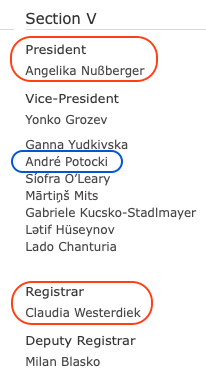
ECHR German Section V

and here is Jürgen Sonneck, criminal civil servant covered from bottom to top.

Hi, I do not always use the false name "C. Paucher" but when I do
I can be sure to be protected by German law officials and the ECHR.

The whole sordid affair here.

6/10/2019

Open letter to President of ECHR Mr. Linos-Alexandre Sicilianos - Mr. President, your Court shuns publicity; your Court failed on all counts miserably “to cause justice to reign over all”

President Sicilianos
© ECHR
F A X


European Court of Human Rights
President: Mr. Linos-Alexandre Sicilianos


cc Federal Ministry of Justice and Consumer Protection, Chancellory Berlin


Case 51482/18 (Single-Judge decision) - German criminal civil servant Jürgen Sonneck who operated under the false name “C. Paucher” protected by ECHR

June 8, 2019

Dear President Sicilianos,

In his classic essay 'The Law' Frédéric Bastiat' wrote:
"The law is the organization of the natural right of lawful defense; it is the substitution of collective for individual forces, for the purpose of acting in the sphere in which they have a right to act, of doing what they have a right to do, to secure persons, liberties, and properties, and to maintain each in its right, so as to cause justice to reign over all."
I am afraid, Mr President, I fail to see that administered by your very Court. As much as I understand the need of streamlining the delivery of justice given the tens of thousands of complaints submitted, Single-Judge decisions fail to achieve that when one subscribes to Bastiat’s tenet.

Rule 18A2 – Non-judicial rapporteurs sadly flies into its face. It is not very reassuring when one reads in Dinah Shelton’s (Professor of International Law Emeritus) "Significantly Disadvantaged? Shrinking Access to the European Court of Human Rights”:
“… the Registry is partly staffed with temporarily seconded personnel paid for by individual states …”
It is disconcerting when Gerards and Glas from the University Utrecht write in "Access to justice in the European Convention on Human Rights system":
“… non-judicial rapporteurs (Registry officers) sift through, assess and categorise the many incoming applications. … these are presented with lists containing single-sentence descriptions of each case. … Relying on the quality of these preparatory documents, the judges usually simply rubber-stamp them, without looking into the file”.
With the Single-Judge decision 51482/18 your Court protected and covered the primitive German criminal civil servant Jürgen Sonneck who had the ass-hatted idea to email a criminal complaint to police using the false name “C. Paucher”, accusing me falsely of hate speech! That amounts to malicious intent. To cover its tracks, your Court which claims to honor and guarantee human rights in the hodgepodge that is Europe, resorts to the destruction of the case files:
“The Court shall not keep the file in its archives for more than one year from the date of this decision”.
The ECHR should have the decency to call Single-Judge decisions what they are: a Registry rapporteur decision signed by a single judge who has not even looked at the case file in toto, “seconded by personnel paid for by individual states” who try their best to keep their country’s image clean. In particular, when the EU paymaster’s and high-reputation country Germany’s image is at stake!

In Rules of Court, 1 August 2018, Registry of the Court, Rule 18A2 – Non-judicial rapporteurs is explained:
1. When sitting in a single-judge formation, the Court shall be assisted by non-judicial rapporteurs who shall function under the authority of the President of the Court. They shall form part of the Court’s Registry.
Incidentally, that is the German Registrar Claudia Westerdiek! The Germans have a saying for that: "Nachtigall, ick hör dir trapsen”.

In ‘The Impartiality of International Judges: Evidence from the European Court of Human Rights’  Erik Voeten, Georgetown University, informs:
"Admissibility decisions are based on the recommendation of a rapporteur, which is usually the national judge of the respondent government, granting that judge considerable leverage over national cases.”
Shai Dothan addresses in ‘The Motivations of Individual Judges and How They Act as a Group’ the country-specific partialities and bias of the ECHR:
Importantly for the purposes of this paper, international courts are also advised to treat different states differently. States that enjoy a high-reputation for compliance with international law pose a greater threat to the court. Their non-compliance or even their criticism can significantly harm the court's reputation. To counter this threat, international courts treat high-reputation states more leniently than they do low-reputation states. They will reserve their most demanding judgments—especially those that are based on doctrinal novelties—to states that have a low-reputation.
This is seconded by Dinah Shelton who again in ‘Significantly Disadvantaged?’ observes:
“As states do not like to be found in violation of their human rights obligations, it is not surprising that they would seek to limit admissibility, even (or especially) in respect to meritorious claims.”
And further in a rather damning description of court proceedings:
“As Cameron has noted and judges on the Court have confirmed in discussions with the author, the lists transmitted electronically to the single judges contain only one or two sentence summaries of each matter recommended for dismissal, identifying the right being invoked; the judges do not see the applications and a few have complained of feeling that they are expected to ‘rubber-stamp’ the decisions of the Registry.”
In footnote 27 it reads:
“The problem of a ‘hidden judiciary’ of secretariat lawyers making the actual decisions is not unique to the European system. Cameron notes that this can create problems of integrity when the Registry is partly staffed with temporarily seconded personnel paid for by individual states: …“
There is no doubt that either the Court in Strasbourg, an inside German government representative, and/or the German government communicated to cover up this incredible and screwed up incident committed by the German civil servant Jürgen Sonneck who has been and is  still being protected and covered by Munich police and the Munich Court, reminiscent of Nazi times.

Is it a mere coincidence that the judicial formation of the Court in Section V is formed among others by Judge Potocki, the Single-Judge in this respective case, and complemented with the Registrar being the German Claudia Westerdiek? And to round off the perfect assemblage, the President of Section V is none other than the German Mrs. Angelika Nußberger.

The ECHR did not even make an effort to conceal its pro high-reputation states bias and blatantly handed my case to the GERMAN Section V to get the whole deeply embarrassing case sterilized and decontaminated. Just as Dinah Shelton laid bare in  "Significantly Disadvantaged? Shrinking Access to the European Court of Human Rights”:
“… the Registry is partly staffed with temporarily seconded personnel paid for by individual states …
… the judges do not see the applications and a few have complained of feeling that they are expected to ‘rubber-stamp’ the decisions of the Registry.”
The Registry being the German Claudia Westerdiek!


When the Court’s decision reads “the Court finds in the light of all the material in its possession and in so far as the matters complained of are within its competence, that they do not disclose any appearance of a violation of the rights and freedoms set out in the Convention or the Protocols thereto and that the admissibility criteria set out in Articles 34 and 35 of the Convention have not been met” and subsequently, “the Court declares the application inadmissible”, it triggers the question what makes this internet meme NOT covered by free speech? Where does the ECHR see a “means of propaganda” in this Marissa Mayer meme?

“(2) Means of propaganda within the meaning of subsection (1) shall only be those writings (Section 11 subsection (3)) the content of which is directed against the free, democratic constitutional order or the idea of international understanding.” - German Criminal Code 86

What makes this image of Hitler in full splendour in DER SPIEGEL’s youth portal ‘Bento’ (the image is about the German political party AfD) legal according to the prosecution in the City of Hamburg? German media is full of such images because Hitler sells.


  • The criminal civil servant J. Sonneck (the same person who filed the complaint underlying ECHR Case 35285/16) uses the false name “C. Paucher” to accuse me falsely of hate speech and armed police dash into the room of my daughter without knocking. Confiscates our computers for the second time! The ECHR buries it by Single-Judge decision.
  • The laptop of my then school-attending Tibetan daughter, is deliberately damaged by the Kangaroo Court Munich. It does not concern the ECHR.
  • Smartphone confiscated without court order by police just like in Nazi times does not bother the ECHR?
  • The same intended with my daughter’s smartphone is fine and my complaint according to Article 35 is “manifestly ill-founded”?
  • Criminal J. Sonneck NOT called by the Munich court for interrogation despite my demand sent to the court and the ECHR sees no plot and coverup?
  • House inside and outside photographed for publishing an internet meme and the ECHR trundles along?
  • Lying Munich judge Bassler poses in all three cases (all based on criminal complaints by German labor agencies (!)) as judge and the Munich court has no judicial business distribution plan. The ECHR considers all this inadmissible under Article 35?
Your Court does not even follow its own set criteria. THE NEW ADMISSIBILITY CRITERION UNDER ARTICLE 35 § 3 (b) OF THE CONVENTION states under section II:
5. In 2010, the High Contracting Parties invited the Court to give full effect to the new admissibility criterion and to consider other possibilities of applying the principle de minimis non curat praetor.6 Further in 2011 the Court has been invited to “give full effect to the new admissibility criterion in accordance with the de minimis principle”.
The ECHR is lamenting an increase of repetitive cases. My case was about an internet meme showing the former Yahoo CEO in a photoshopped Nazi uniform and a text about ‘Work from Home’. I am not not aware of any case where the ECHR was confronted with an internet meme. So it was clearly not de minimis nor was it repetitive. It was, however, deeply damaging for Germany, embarrassing in its stupidity and a further proof of the absence of free speech in Germany. Such a complaint has to be thrown out and ultimately any evidence destroyed to keep the image of Germany untainted.

As Shai Dothan noted:
“… international courts are also advised to treat different states differently. States that enjoy a high reputation for compliance with international law pose a greater threat to the court. Their non-compliance or even their criticism can significantly harm the court's reputation. To counter this threat, international courts treat high-reputation states more leniently than they do low-reputation states."
Your Court’s Section V with German Registrar Westerdiek delivered and did a splendid job of covering up a sordid scheme that only a screwed up and heinous German civil servant could have concocted.

With all due respect, Mr President, I can't help but to reminisce Bertrand de Jouvenel:

“Observation and introspection have convinced me that,
even in our times of numerous and detailed laws,
men are in fact ruled much less by laws than by compulsive
internal images of what they should do – behavioral models;
that their conduct is not a matter of personal fancy
within the limits set by legal obligations,
  but gravitates around their behavioural image,
which itself alters over time; …”

These “political phenomena” (de Jouvenel) are the very construct of the ‘Rotten Heart of Europe’ (Bernard Connolly), an entity based on the fact that Europe comprises of different and ill-fitting nation states. When one reads "The Court shall not keep the file in its archives for more than one year from the date of this decision”, Jeremy Bentham springs to mind:

“Publicity is the very soul of justice.”

Mr. President, your Court shuns that publicity; your Court failed on all counts miserably “to cause justice to reign over all”.

Thank you,

. . . . . . . . . . . .

ECHR Sections

The German Registrar Claudia Westerdiek.
You could say she is in that position since decades.

To be followed by a letter to the German Registrar Westerdiek.

5/03/2019

What do the Euro Clowns at the ECHR do with their tens of thousands infamous Single-Judge decisions?

ECHR digs
(with Single-Judge decision
incinerator?)
That question arises when they write to you:

01/17/2019

Complaint 51482/18

"The Court shall not keep the file in its archives for more than one year from the date of this decision.

The Registry of the European Court of Human Rights"

What would you do if you want to cover your tracks, keep the image of a decent institution devoted to human rights, wellbeing and, well, to atone for the various cultural, political and other whims of these so disparate European nation states, you sprinkle in some of that magical potion called "Margin of Appreciation"?

The number of Single-Judge decisions in 2011 was 100,000, in 2015 they struck out 36,300 complaints, in 2016 they eliminated 30,100 cases, in 2017 out went 60,150 complaints and 2018 some 33,200 cases got the axe.

Burn the whole shit! What else! After all, your image is at stake. So to imagine an incinerator inside the ECHR would not be that far off.

Let us consult the lofty European Convention on Human Rights.
ARTICLE 24
Registry and rapporteurs
2. When sitting in a single-judge formation, the Court shall be assisted by rapporteurs who shall function under the authority of the President of the Court. They shall form part of the Court’s Registry.
Oh really? It is BULLSHIT because in Rule 18A2 you read about "Non-judicial rapporteurs". You heard that right, NON-JUDICIAL rapporteurs!

Rules of Court, 1 August 2018, Registry of the Court, Strasbourg.
Rule 18A2 – Non-judicial rapporteurs
1. When sitting in a single-judge formation, the Court shall be assisted by non-judicial rapporteurs who shall function under the authority of the President of the Court. They shall form part of the Court’s Registry.
Here is Dinah Shelton of George Washington University Law School in "Significantly Disadvantaged? Shrinking Access to the European Court of Human Rights"
"Cameron notes that this can create problems of integrity when the Registry is partly staffed with temporarily seconded personnel paid for by individual states: see ibid. at 34."
There is no doubt that either the Court in Strasbourg contacted the German government or the German government got into contact with the Court to cover up this incredible fucked up incident committed by the full-blown Useful Idiot cum civil servant Jürgen Sonneck operating under the false name "C. Paucher".

Jürgen Sonneck alias "C. Paucher"

Here is why:
"Importantly for the purposes of this paper, international courts are also advised to treat different states differently. States that enjoy a high-reputation for compliance with international law pose a greater threat to the court. Their non-compliance or even their criticism can significantly harm the court's reputation. To counter this threat, international courts treat high-reputation states more leniently than they do low-reputation states. They will reserve their most demanding judgments—especially those that are based on doctrinal novelties—to states that have a low-reputation."
Or as Dinah L. Shelton put it:
"As states do not like to be found in violation of their human rights obligations, it is not surprising that they would seek to limit admissibility, even (or especially) in respect to meritorious claims."
Here is a damning assessment in "Access to justice in the European Convention on Human Rights system" by Gerards and Glas from Utrecht in The Netherlands:
"It has been well documented that non-judicial rapporteurs (Registry officers) sift through, assess and categorise the many incoming applications. When they allocate cases to the single judges, these are presented with lists containing single-sentence descriptions of each case."
It gets better:
"Relying on the quality of these preparatory documents, the judges usually simply rubber-stamp them, without looking into the file.
Given that the single-judge decisions currently make up nearly 80% of all the applications disposed of, this means that in all these cases, the decisions are taken in substance by Registry staff. This may be problematic from a perspective of independence, since it means an important responsibility for non-judicial rapporteurs who do not need to meet the strict requirements that are set for judges."
That fulfills the essentials for a Clown Court.
"Macdonald, a former judge of the ECtHR, has pointed out that the whole system of European human rights protection ‘rests on the fragile foundations of the consent of the Contracting Parties’. Macdonald, ‘The Margin of Appreciation’ in Macdonald, Matscher and Petzold (eds), The European System for the Protection of Human Rights (1993)."
The problem of Europe is that it is a hodgepodge of culturally, politically and judicially different nation states without a common goal or aspiration.
"The Strasbourg Court does not sit at the apex of an integrated court structure. Rather, it is a court set up by a treaty among participating countries, and it operates independently of the courts of any of the member states. It exists solely to interpret and apply the provisions of the Convention, and there is no national body of law upon which it is competent to rule. The participating countries do not share a common source of law and have major cultural differences. A substantial number are, at best, emerging democracies. The problems of administering a single system of fundamental rights in such a context can be formidable. Thus, there are legitimate issues as to exactly what the nature of the review of member state decisions should be."

The Euro Clowns at the ECHR, their infamous Single-Judge decisions and their "Non-judicial rapporteurs"


Protecting and covering up the German civil servant criminal Jürgen Sonneck posing as " C. Paucher" under an assumed name.

Jürgen Sonneck alias "C. Paucher"

4/23/2019

The Euro clowns of the ECHR in Strasbourg know very well they have to treat high-reputation states more leniently than low-reputation states

A German civil servant using a false name?
No sweat, Euro clowns judge Potocki will cover that up for ze Germans.
Case 51482/18 (Single-Judge decision)

The Motivations of Individual Judges and How They Act as a Group (Pdf)

By Shai Dothan
The judicial tactics used by courts are complicated and context-specific. An interesting, perhaps counter-intuitive result, is that courts build their reputation by deliberately issuing demanding judgments and using reasoning techniques that expose their discretion. Compliance with such judgments is harder and more unexpected and that is why when states do comply, they send a potent signal that boosts the court's reputation.
Importantly for the purposes of this paper, international courts are also advised to treat different states differently. States that enjoy a high-reputation for compliance with international law pose a greater threat to the court. Their non-compliance or even their criticism can significantly harm the court's reputation. To counter this threat, international courts treat high-reputation states more leniently than they do low-reputation states. They will reserve their most demanding judgments—especially those that are based on doctrinal novelties—to states that have a low-reputation.
There is more. Here is the University of Birmingham. It is highly recommended to read their paper!

Managing judicial innovation in the European Court of Human Rights (Pdf)

by De Londras, Fiona; Dzehtsiarou, Kanstantsin
What this suggests, at the very least, is that the ECtHR is acutely aware of the political context in which its decisions are made and, indeed, of the extent to which it is on safe or shaky ground in the eyes of the relevant state party; considerations that become even more acute in situations in which sovereigntist urges might be said to run high. 
About the ECHR's "apparent willingness to treat different states somewhat differently in this context".
Managing Sovereigntist Inclinations
While issues that go to a state’s perceived identity bring about a reluctance to submit to international supervision on the part of states, matters that are seen to have existential implications for the state can draw out sovereigntist inclinations. In other words, in relation to these issues states can feel not only inclined but also justified in distancing themselves from international supervision and may instead concentrate on engaging with and within their domestic legal systems, making international courts’ supervision of these issues particularly difficult. This is clear from a consideration of the ECtHR’s treatment of national security cases and, in particular, its apparent willingness to treat different states somewhat differently in this context. 
Who would even dare to suggest that this august European Court "may well be susceptible to capture"?
If, as we suggest above, the Court sometimes takes cognisance of non-legal factors including the possible implications for its own position of taking an innovative approach to a question before it, it may well be susceptible to capture.
As Shai Dothan put it, "high reputation states" may even " influence the outcome unduly". There is absolutely no doubt that the German administration was involved in getting Case 51482/18 thrown out!
In other words, there is a possibility that in either deciding whether to hear the case at all or in reaching its final decision on a case the Court may take into account contracting parties’ reactions and allow this to influence the outcome unduly.
Or, as Lorenzo Zucca, for instance, criticised in footnote 57:
"what the ECtHR does not seem to understand is that its legitimacy as an international court of human rights also crucially depends on the quality of its reasoning, which should be regarded as exemplary in articulation and depth. Without those qualities, any decision is a defeat for justice even if it may be a Pyrrhic victory for institutional respectability" Zucca, ‘Lautsi: A Commentary on a Decision by the ECtHR Grand Chamber’ (2013) 11 International Journal of Constitutional Law 229.
The EU is known for highly dissenting and quarrelling member states which is no wonder given the history of Europe as a whole and this can and does lead to "fragile foundations of the consent of the Contracting Parties". Footnote 102 reads:
Macdonald, a former judge of the ECtHR, has pointed out that the whole system of European human rights protection ‘rests on the fragile foundations of the consent of the Contracting Parties’. Macdonald, ‘The Margin of Appreciation’ in Macdonald, Matscher and Petzold (eds), The European System for the Protection of Human Rights (1993) 83 at 123.
 How about this to conclude?
"It has been well documented that non-judicial rapporteurs (Registry officers) sift through, assess and categorise the many incoming applications." 
This is from "Access to justice in the European Convention on Human Rights system" by Gerards and Glas from Utrecht in The Netherlands.

4/21/2019

European Court of Human Rights ....... a VIP box of cardsharks? You betcha!


The video is in German. What he is basically saying is:

Our judiciary is incurably degenerate. It is an expiring soviet model where first-instance procedural truths from the higher courts to the European Court of Human Rights (ECtHR) are copied / pasted without plausibility testing.

One apparatchik controls the other. Nothing clever can come out of that. Of the 60 to 70,000 complaints that end up in Strasbourg every year, 90 to 98% are unfounded with a half-page text module. The complaints are not even read. Then they are destroyed.

Case Switzerland: On the occasion of the 40th anniversary of the Swiss Confederation's accession to the European Convention on Human Rights, our Foreign Minister Didier BURKHALTER congratulated himself on the fact that Strasbourg only approved 1.6% of all claims from Switzerland (Bundesrat report of 19.11.2014). Wanted to say: We have the perfect constitutional state. The whole world believes that.
(Google translate)
. . . . . . . .

Here is an excerpt from the excellent paper 'Significantly Disadvantaged? Shrinking Access to the European Court of Human Rights' authored by Dinah L. Shelton, Manatt/Ahn Professor of International Law Emeritus
Address:
2000 H Street, NW
Washington, District Of Columbia 20052

I have meanwhile read quite some papers with particular view on these so-called Single-Judges decisions and I have to say, without any intent to flatter her, Dinah Shelton's paper is the most outspoken. Here goes:

"As states do not like to be found in violation of their human rights obligations, it is not surprising that they would seek to limit admissibility, even (or especially) in respect to meritorious claims.

Currently, the Registry undertakes an initial evaluation of applications. A nonjudicial rapporteur from the Registry decides whether the application should be assigned to a single judge, a Committee or a Chamber, and assists the single judges, transmitting the lists of cases deemed inadmissible to the judges for approval. The President of the Court decides on the number of judges designated to sit as single judges and appoints them to serve for a period of one year. The Rules of Court provide that where the material submitted by the applicant is ‘on its own’ sufficient to disclose that the application is inadmissible or should be struck out of the list, it is to be considered by a single judge unless there is some special reason to act to the contrary. The single judge may declare inadmissible or strike out the application without further examination or appeal, notifying the applicant of the decision by letter. As Cameron has noted and judges on the Court have confirmed in discussions with the author, the lists transmitted electronically to the single judges contain only one or two sentence summaries of each matter recommended for dismissal, identifying the right being invoked; the judges do not see the applications  (26) and a few have complained of feeling that they are expected to ‘rubber-stamp’ the decisions of the Registry. Once the application is rejected, the author of it is sent a form letter so indicating, without explanation or reasoned decision, simply stating that ‘taking ac- count of all the elements in its possession, and to the extent that it is able to evaluate the allegations formulated’, the Court sees no reason to proceed.

(26) Cameron, ‘The Court and the Member States: Procedural Aspects’ in Andreas Follesdal et al. (eds),Constituting Europe: The European Court of Human Rights in a National, European and Global Context (2013) 25 at 33. Lack of access to the applications is understandable because the single judge is unlikely to comprehend the many different languages of the applications.
(27) The problem of a ‘hidden judiciary’ of secretariat lawyers making the actual decisions is not unique to the European system. Cameron notes that this can create problems of integrity when the Registry is partly staffed with temporarily seconded personnel paid for by individual states: see ibid. at 34."

There is more good stuff in her paper.

. . . . . . . . .

Here are some comments of victims under the Single-Judges regime.

What a disgrace these single-judge decision are and here.

. . . . . . . . .

ECHR Judge Potocki's decision reeks to high heaven and is an insult to any democratic being! The ECHR is covering a criminal. But what else would you expect from fucking Europe?!

"Publicity is the very soul of justice.” - Jeremy Bentham

3/20/2019

Sir Humphrey Appleby II on ECHR Single-judge decisions and the "epistemological problems of sufficient magnitude" and "the fourth of the epithets"

Judge Potocki unperturbed by
"epistemological problems laid
upon the semantic resources"
Sir Humphrey conveys his reservations about the unfortunate Single-judge decision in Case 51482/18 to Judge Potocki:

"Unfortunately, although the answer decision was indeed clear, simple and straightforward, there is some difficulty in justifiably assigning to it Single-judge decisions the fourth of the epithets you applied to the statement inasmuch as the precise correlation between the information you communicated and the facts insofar as they can be determined and demonstrated is such as to cause epistemological problems of sufficient magnitude as to lay upon the logical and semantic resources of the English language a heavier burden than they can reasonably be expected to bear."


"I wonder if there's anything that might persuade you to consider recasting that sentence that Single-judge decision and transferring the emphasis from the specific instance to the abstract concept without in any way, impairing the conceptual integrity of the theme Court."

Yes Minister (1980) s01e02 Episode

"Well, it was a conversation to the effect that in view of the somewhat nebulous and inexplicit nature of your the ECHR remit Single-judge decisions and the arguably marginal and peripheral nature of your influence on the central deliberations and decisions within the political judicial process, that there could be a case for restructuring their action priorities in such a way as to eliminate your the (decision's) liquidation from their immediate agenda.

And to that end, I recommend that we set up an interdepartmental committee with fairly broad terms of reference so that at the end of the day we'll be in the position to think through the various implications (of Single-judge decisions) and arrive at a decision based on long-term considerations (and margins of appreciation) rather than rush prematurely into precipitate and possibly ill-conceived action which might well have unforeseen repercussions."

3/18/2019

"I have been told by lawyers familiar with the ECHR that they have seen applications that did appear to present serious issues but which were, nevertheless, rejected as "manifestly unfounded"."

Here is an excerpt of "The European Court of Human Rights: What It Is, How It Works, and Its Future" by McKaskle, Paul L. (2005).

First, in the United States a judge and the law clerks hired by him or her develop an individual relationship that usually reflects the priorities (and even the biases) of the judge. In the Strasbourg Court, however, the Registrar's staff is answerable to the Registrar, and not to individual judges. The Registrar's staff prepares the initial analysis of all cases, is present in Chamber deliberations, and probably prepares most opinions of the Court. What effect this relationship has on the jurisprudence of the Strasbourg Court is impossible for an outsider to know. For some judges the effect may well be minimal or non-existent. But it is possible that the staff views might have an effect on new judges or judges not entirely comfortable with the English or French language. 168 Extensive use of a central legal staff may also result in greater bureaucratic or institutional decision-making.

Second, in part, the legal staff (serving as the equivalent of an American law clerk) does carry out duties typical of the position, such as an analysis of each application filed with the Court as to whether it should be admissible because the allegations suggest that there has been a violation of the Convention. But the duties go further. Pursuant to Rule 22 of the Rules of Court, the Registrar or his designee is present during deliberations of a Committee, Chamber, or Grand Chamber. (171) The rules provide that "only judges shall take part in the deliberations,"' but it is not hard to imagine that many questions may well be put to the Registrar or other legal staff present, and thus the responses of staff constitute a de facto participation.

171. ECHR Rules, supranote 40, R. 22. Rule 22 also provides that "other officials of the Registry and interpreters whose assistance is deemed necessary" may also be present during deliberations. Id. In the United States Supreme Court, law clerks never participate in conferences, and such a practice is extremely rare in the California Supreme Court.

...

The Strasbourg Court, on the other hand, is presumably obligated to accept and decide any case presented to it that credibly alleges a violation of the Convention. This has led to an explosion in the number of cases considered by the Court. Further, this explosion in case numbers is exacerbated by the inability of the Court to decide cases on a summary basis and by the lack of a mechanism to remand to a national court for reconsideration based on Strasbourg court prior decisions.

Nevertheless, the use of the word "presumably" in the previous paragraph is done advisedly. Though there is nothing in the Convention or the Rules of the Court granting discretion to ignore what, prima facie, appear to be credible claims, some observers of the Court suspect that a substantial amount of discretion is exercised in rejecting cases. The ratio between the number of applications for relief filed with the Court and the number of cases actually taken gives some credence to this suspicion. For example, in 2004 there were decisions on admissibility on over 21,000 applications, but only 830 cases were deemed worthy of further consideration. While undoubtedly a fair number of applications are unfounded, it seems surprising that close to ninety-seven percent of them are unable to even allege a prima facie credible violation. (253) But without further information, questions about the Court's exercise of discretion in choosing which cases to hear are merely a matter of conjecture.

253. The vast majority of applications filed are rejected as being "manifestly ill-founded" (the term used when a case is rejected by a Committee). Convention, supranote 12, art. 35(3); Wildhaber, Oslo Speech, supranote 154, at 6 (noting that manifestly inadmissible cases constitute ninety percent of applications). It may be that some of the applications are made by lay individuals who have no knowledge of the scope of the Court's jurisdiction, but it would seem probable that many of the applications are made with the assistance of a lawyer who is acquainted with the relevant provisions of the Convention and would not file an application that had little or no chance of succeeding. So, it is at least surprising that the ratio of summary rejection is so high. Further, I have been told by lawyers familiar with the Court that they have seen applications that did appear to present serious issues but which were, nevertheless, rejected as "manifestly unfounded." While rejected applications are, in theory, available for public inspection, the procedure to see a file is tedious. A file has to be specifically requested in writing, and a time must be set up to examine it under the supervision of a member of the Registrar's staff and general requests for multiple files cannot be made. See European Court of Human Rights, Press, http:// www.echr.coe.int/ (follow "Press" hyperlink; then follow "Rules on access to case files" hyperlink). Further, applications may be written in any one of the thirty-seven languages used in the member states, and if rejected at an early stage, are not translated. WORKING METHODS REPORT, supra note 97, at 11. So, as a practical matter it is impossible to determine whether this occurs regularly or are isolated events-or are simply mistakes of the observers as to whether the rejected applications are, in fact, meritorious. Thus, at best it is only a suspicion that there currently exists at least some exercise of discretion in deciding whether the Court will consider a case. See also OVEY & WHITE, supra note 25, at 404 (expressing concern that summary rejection of applications by Committees without explanation will "no longer build up an easily consulted body of decisions clarifying the grounds of inadmissibility").

352. In terms of the present caseload, it is possible that the Court is already exercising discretion in deciding whether to take cases which seem to present issues of "minor or secondary importance." The vast majority of applications filed are rejected as being " man- ifestly ill-founded'" (the term used when a case is rejected by a Committee). Id It may be that many of the applications are made by individuals who have no knowledge of the scope of the Court's jurisdiction, but it would seem probable that many of the applications are made with the assistance of a lawyer who is acquainted with the relevant provisions of the Convention and would be unlikely to file an application that had no chance of succeeding. So, it is at least surprising that the ratio of summary rejection is so high. Further, I have been told by lawyers familiar with the Court that they have seen applications that did ap- pear to present serious issues but which were, nevertheless, rejected as "manifestly ill- founded." Since rejected applications are not easily accessible for public inspection, it is impossible to determine whether this is a systematic occurrence or are isolated events-or are simply mistakes of the observers as to whether the rejected applications are, in fact, meritorious. Thus, at best there is only a suspicion that there is at least some exercise of discretion in deciding whether the Court will consider a case.

The problem is, Europe is a hodgepodge of very different participating countries that "do not share a common source of law and have major cultural differences. A substantial number are, at best, emerging democracies". Go figure!

B. The Caseload Problem May Be Far Worse than Officially Recognized 

 ... One cannot overemphasize the potential of future cases resulting from the admission of the newer member states as a major factor in the continuing increases in the caseload of the Court. At present the number of judgments against the recently admitted states is not great, (372) but this number may escalate. Most of the member states are, at best, emerging democracies and several have a recent history of violence and repression. (373)


Here is a further interesting read in the German Law Journal Vol. 19 No. 07

The Motivations of Individual Judges and How They Act as a Group
By Shai Dothan

D. People Who Are Not Judges

I. Legal Staff

It is easy to adopt the misleading view that judges are the only people who really matter in international courts. After all, judges are the ones who sign judgments, and therefore it is natural to assume that it is only judges who make important policy decisions. But this imaginary view is probably mistaken with regards to many international courts.

Scholars have noted that the ECHR has a very influential legal staff, partly because judges who are not proficient in English and French, the two official languages of the court, must rely very closely on staff members.58 In many international courts, especially criminal courts, the staff can number hundreds of experienced professionals.59 It is naïve to think that these experts do not affect judicial policy.

To the extent one believes the legal staff is diverse and unbiased, the substantial impact of this staff may be a blessing. It could mitigate the influence that biased judges have on the practices of the court. But if the legal staff is hierarchically controlled, the people on the top of the pyramid may form a danger of an entirely different magnitude. In the ECHR, for example, all the staff members answer directly to the Registrar. The Registrar, in turn, is under the authority of the court's President. If either the Registrar or the President are biased, this bias could echo throughout the entire legal staff.

If the staff or the people controlling it are biased, they may direct the entire court to suit their preferences. This suggests that empirical research should not stop at investigating the selection of international judges. It should also study the selection and promotion of other legal staff within international courts, and it should put special emphasis on the positions in the court that control the legal staff.

II. Lawyers and NGOs as Repeat Players

Courts do not work in isolation. They constantly interact with lawyers who bring cases to the court, argue before it, and significantly affect the content of its decisions. Research has shown that many of the lawyers who appear before international courts are "repeat players"—they litigate before the same court numerous times.60 These repeat players gain legal expertise and connections that give them a unique influence on the policy made by the court. Just like with the legal staff on the court, this influence may either mitigate or exacerbate the biases of the judges depending on the nature of the legal community surrounding the court.

And read this:

Importantly for the purposes of this paper, international courts are also advised to treat different states differently. States that enjoy a high-reputation for compliance with international law pose a greater threat to the court. Their non-compliance or even their criticism can significantly harm the court's reputation. To counter this threat, international courts treat high-reputation states more leniently than they do low-reputation states. They will reserve their most demanding judgments—especially those that are based on doctrinal novelties—to states that have a low-reputation.

Obviously, this form of behavior is a threat to judicial objectivity. To the extent that individual judges are pressured to serve the court's long-term interest in this way, it may make them far more biased than any personal incentive discussed above. Judges may use ingenious ways to profess evenhandedness even as they pursue the dangerous course that promises their court greater power in the future.

Finally the

F. Conclusion

The reader clearly realized by this point that this paper offers more questions than answers. The power of Judicial Behavior studies—at least for the purpose of this paper—is that it allows scholars of international courts to ask the right questions.

The finding that international judges are biased in favor of their home countries is incredibly robust.
...

Sir Humphrey Appleby II on ECHR Single-judge decisions and the "epistemological problems of sufficient magnitude" and "the fourth of the epithets"

3/14/2019

ECHR Single-judge Decisions always lead to an Inadmissibility decision???

Color me ignorant but the way I understand it "this flow chart indicates the progress of a case by judicial formation" and the only way I can interpret it is indeed:

ECHR Single-judge Decisions always lead to an Inadmissibility decision.

ECHR Single-judge Decisions always lead to an Inadmissibility decision???

This means once a case is referred to a single judge the decision has already been made. There is no other logical way to see this differently.

Here is an excerpt from "The European Court of Human Rights: What It Is, How It Works, and Its Future" by McKaskle, Paul L. (2005).
In the Strasbourg Court, however, the Registrar's staff is answerable to the Registrar, and not to individual judges. The Registrar's staff prepares the initial analysis of all cases, is present in Chamber deliberations, and probably prepares most opinions of the Court. What effect this relationship has on the jurisprudence of the Strasbourg Court is impossible for an outsider to know.
In footnote 253 it reads:
Further, I have been told by lawyers familiar with the Court that they have seen applications that did appear to present serious issues but which were, nevertheless, rejected as "manifestly unfounded." While rejected applications are, in theory, available for public inspection, the procedure to see a file is tedious.
It is not only tedious, it is purged from public view:

"shall not keep the file in its archives for more than one year from the date of this decision."

Judge André Potocki

"I have been told by lawyers familiar with the ECHR that they have seen applications that did appear to present serious issues but which were, nevertheless, rejected as "manifestly unfounded"."

3/12/2019

In addition, confiscation of smartphone without court order no concern for "Euro clowns" at ECHR (Case 51482/18)

Great headline, right? Gathered it from Erik Voeten (more below):
"This scrutiny is sometimes targeted at individual judges. For example, the popular British tabloid The Sun individually singled out the “Euro clowns” it held responsible for the decision to stay the extradition of radical Muslim cleric Abu Hamza to the United States.9 (Hamza claimed he faced the prospect of torture in a U.S. prison.)"
Here is a measured post about that SUN headline “Euro Clowns Let Hamza off the Hook,” August 7, 2008. Still, I like the moniker 'Euro Clowns' as the EU totally gets on my balls. Having outed myself again, here is the

Relevant excerpt from our complaint submitted to the ECHR:

Subject Art 8 ECHR

A confiscation of the smartphone was not mentioned in the Judicial Decision of October 8, 2015. Nevertheless, it was confiscated by the police and it can also be assumed, the same was planned with the smartphone of his daughter, as a policewoman was present. Despite this unlawfulness, Judge Birkhofer-Hoffmann showed a keen interest in the results of the evaluation of phone data. For Hartz 4 recipients no rights seem to apply.

In a decision of February 4, 2005 - 2 BvR 308/04, the Federal Constitutional Court stated in paragraph 23 to 25 clear limits for a confiscation. On Nov. 22, 2016, the applicant filed a criminal complaint against police officer Carstens at the Munich Public Prosecutor's Office. Furthermore, he sent two Pdf to the police chief of Munich, which was allegedly handed to the prosecutor by the police according to their letter of April 26, 2017. The complainant has no correspondence with the file # 120 Js 119571/17, as was claimed by senior prosecutor Tilmann in the letter of June 1,2017 and again confirmed on Oct. 19, 2017. Everything was swept under the carpet.


To give that single-judge decision (Case 51482/18) the right twist we at the ECHR simply
"shall not keep the file in its archives for more than one year from the date of this decision."
There is an interesting paragraph in "The European Court of Human Rights: What It Is, How It Works, and Its Future" by McKaskle, Paul L. (2005) that explains the workings inside the ECHR and the national component. The pivot is the Registrar and his/her staff!
In the Strasbourg Court, however, the Registrar's staff is answerable to the Registrar, and not to individual judges. The Registrar's staff prepares the initial analysis of all cases, is present in Chamber deliberations, and probably prepares most opinions of the Court. What effect this relationship has on the jurisprudence of the Strasbourg Court is impossible for an outsider to know. For some judges the effect may well be minimal or non-existent. But it is possible that the staff views might have an effect on new judges or judges not entirely comfortable with the English or French language. 168 Extensive use of a central legal staff may also result in greater bureaucratic or institutional decision-making.
Second, in part, the legal staff (serving as the equivalent of an American law clerk) does carry out duties typical of the position, such as an analysis of each application filed with the Court as to whether it should be admissible because the allegations suggest that there has been a violation of the Convention. But the duties go further. Pursuant to Rule 22 of the Rules of Court, the Registrar or his designee is present during deliberations of a Committee, Chamber, or Grand Chamber. (171) The rules provide that "only judges shall take part in the deliberations,"' but it is not hard to imagine that many questions may well be put to the Registrar or other legal staff present, and thus the responses of staff constitute a de facto participation.
171. ECHR Rules, supranote 40, R. 22. Rule 22 also provides that "other officials of the Registry and interpreters whose assistance is deemed necessary" may also be present during deliberations. Id. In the United States Supreme Court, law clerks never participate in conferences, and such a practice is extremely rare in the California Supreme Court.
Even more embarrassing is this part in a footnote:
 I have been told by lawyers familiar with the Court that they have seen applications that did ap- pear to present serious issues but which were, nevertheless, rejected as "manifestly ill- founded." Since rejected applications are not easily accessible for public inspection, it is impossible to determine whether this is a systematic occurrence or are isolated events-or are simply mistakes of the observers as to whether the rejected applications are, in fact, meritorious. 
The ECHR employs double standards in the form of leniency towards "high-reputation states", or make that EU paymasters.
Importantly for the purposes of this paper, international courts are also advised to treat different states differently. States that enjoy a high-reputation for compliance with international law pose a greater threat to the court. Their non-compliance or even their criticism can significantly harm the court's reputation. To counter this threat, international courts treat high-reputation states more leniently than they do low-reputation states. They will reserve their most demanding judgments—especially those that are based on doctrinal novelties—to states that have a low-reputation.

Here is ERIK VOETEN, Georgetown University, with "The Impartiality of International Judges: Evidence from the European Court of Human Rights"
"About one-third of all applications are dismissed for procedural reasons by the registry. Another 60% of applications are declared inadmissible by unanimous decision of a committee of three judges, most frequently because the applicant had not exhausted domestic judicial remedies. Admissibility decisions are based on the recommendation of a rapporteur, which is usually the national judge of the respondent government, granting that judge considerable leverage over national cases."
The myth of the independent judge.
"Cultural factors could also be responsible for the apparent national bias of international judges. For example, Hensley (1968) attributes national bias on the ICJ to “the more subtle influence of culturally inculcated values” (p. 568), although he does not specify a precise mechanism through which culture has such an effect. One plausible mechanism is that judges who are accustomed to political interference domestically are more likely to defer to the position of their government when serving on an international court."

And let's not forget the fucking stupid criminal civil servant Jürgen Sonneck alias "C. Paucher". Covered by Munich police and the rotten Munich Court. Roland Freisler would admire them blokes.

Hi, my name is Jürgen Sonneck.
I do not always use a false name but when I do, I make sure
I come come across as totally fucking bonkers.
ECHR Single-judge Decisions always lead to an Inadmissibility decision???