Posts mit dem Label netzwerkdurchsetzungsgesetz werden angezeigt. Alle Posts anzeigen

7/22/2019

Sexistischer Affront, wenn epistemische Schäden bei Martina Musati, Arbeitsagentur Stuttgart, einfach so akzeptiert werden

Oberlandesgericht Stuttgart

Olgastraße 2
70182 Stuttgart

(cc Arbeitsagentur Stuttgart, JC München)

22. Juli 2019

Az. 16 Zs 988/19
Az. 112 Js 48272/19

Ermittlungsverfahren gegen Martina Musati wegen Nötigung u.a. (Beschwerde bei Google basierend auf dem Anti-Art. 5 GG NetzDG von Sozialist Heiko Maas & Konsorten)

Verehrtes schwäbisches Gericht,

Ich erhielt mit Schreiben vom 16.07.2019 von Oberstaatsanwältin Hartwig das verlockende Angebot, gegen ihren ablehnenden Bescheid beim OLG Antrag auf gerichtliche Entscheidung mittels Rechtsanwalts zu stellen.

Diesem Fall liegt zugrunde eine - selbstverständlich in Deutschland - anonyme Beschwerde einer dritten Person der neoliberalen Arbeitsagentur Stuttgart, nach der sich die im fortgeschrittenen Alter noch ledige beamtete Dame Martina Musati “diffamiert und verleumdet” fühlt durch Zitate aus Werken des eminenten französischen Sozialphilosophen Pierre Bourdieu und einem bekannten abgewandelten Prinzips aus der Welt des Business, dem Peter Principle. Mit anderen Worten, wir befinden uns mitten in einer mediokren Provinz des sedimentären Intellekts, auch bekannt unter dem Namen ‘Beamtentum’.

So ich das Angebot von Frau Staatsanwältin Hartwig überdachte, fielen mit zwei Aufsätze ein zum Thema “Epistemologie und Luft ablassen” (Venting as Epistemic Work), denn um Letzteres handelt es sich ja bei der Beschwerde bei Google in altruistischer Sorge um prä-menopausale Mamsell.

So heisst es im Papier "Venting as epistemic work” von Juli Thorson und Christine Baker (2019) im Abstractum (Google translate; Hervorhebungen durch mich):
“Wir behaupten, dass Luft ablassen eine epistemische Arbeit sein kann: Wenn man sich an die richtige Art von Person wendet, kann man Wissen über eine unterdrückerische Gesellschaftsstruktur, ihren Platz darin und darüber gewinnen, wie man den epistemischen Schaden, den sie verursacht, repariert. Um diese Behauptung zu rechtfertigen, definieren wir sowohl epistemischen Schaden als auch Luft ablassen und kontrastieren Luft ablassen mit verwandten Begriffen wie Beschwerden und Schimpfen. Anhand des Verständnisses von Code für Zeugnis, Dotsons Begriff des sprachlichen Austauschs und Frickers Unterscheidung zwischen Zeugnis- und hermeneutischer Ungerechtigkeit beschreiben wir, wann und wie Luft ablassen epistemisch ist. Wir diskutieren auch, wie sich Luft Ablassen von Bewusstseinsbildung unterscheidet. Wir schließen daraus, dass, obwohl ein Ziel des Luft Ablassens darin besteht, epistemische Schäden bei einzelnen Frauen zu reparieren, die positive epistemische Wirkung des Luft Ablassens Frauen auf die Bekämpfung hermeneutischer Ungerechtigkeiten vorbereitet.”
Dies ist offenbar bei der schwäbischen Staatsanwaltschaft nicht genügend berücksichtigt worden und dies scheint mir in Zeiten von genderspezifischen Themata, die den gesellschaftlichen Diskurs ja geradezu durchtränkt haben, ein arges Manko. Bei Arbeitsagenturen darf man ohnehin jeden epistemischen Anspruch diskontieren. Es muss als sexistischer Affront gewertet werden, wenn epistemische Schäden bei einzelnen Behörden-Frauen nolens volens akzeptiert werden.

Wie es der Zufall will, erschien ein weiterer Aufsatz zu diesem Thema, der bedauerlicherweise auch en passant arge Zweifel am Verstand besagter lediger Arbeitsbehörden-Beamtin Mademoiselle Musati aufkommen lässt. In "On the Successfulness of Venting and Its Venues" von Manuel Padilla Cruz, Universidad de Sevilla, wird zu bedenken gegeben (wieder Google translate):
“Schließlich setzt seine wesentliche Bedingung voraus, dass das Luft Ablassen ein Versuch des Luftablassers sein muss, dem Publikum zu erkennen zu geben, dass der fragliche Sachverhalt sie negativ beeinflusst hat, und eine Vielzahl von Gefühlen wie Empörung, Wut, Enttäuschung, Angst usw. hervorruft.”
Dies ist nun nirgendwo zu finden in dieser ridikülen Google Beschwerde und es muss unterstellt werden, wenn man die intellektuell äusserst dürftige Beschwerde bei Google durch diese teutonische Arbeitsbehörde liest, dass nicht einmal elementarste kognitive Intelligenz zu erahnen ist, geschweige denn die Lektüre von Pierre Bourdieu. Selbiges muss allerdings auch der schwäbischen Staatsanwaltschaft vorgehalten werden. Dies düpiert doch ein wenig, so doch die Deutschen das ‘Volk der Dichter und Denker’ sind.

Völlig untergegangen scheint mir bei der Stuttgarter Staatsanwaltschaft und es muss hier einmal mehr beklagt werden, wie üblich bei der beamteten Suffragette des neoliberalen Arbeitsverordnungsamtes Martina Musati, die folgende Beobachtung des Autoren:
"Andererseits sind Äußerungen öffentlich, d.h. wahrnehmbar, hörbar - Darstellungen von entweder anderen privaten Darstellungen - d.h. Gedanken, Überzeugungen - oder andere öffentliche - d.h. Äußerungen anderer Personen. Aus diesem Grund sind Äußerungen Metadarstellungen der eigenen Gedanken des Sprechers, aber sie können auch verwendet werden, um die anderen Personen zugeschriebenen Gedanken oder die Äußerungen, die sie (möglicherweise) hervorgebracht haben, zu metadarstellen.
Im ersteren Fall sind Äußerungen beschreibende Metadarstellungen; In letzterem Fall handelt es sich um attributive Metadarstellungen, sofern es eine (leicht) identifizierbare Quelle für diese Gedanken oder Äußerungen gibt. Wenn Äußerungen, die zugeschrieben werden, die Gedanken oder Worte anderer Personen widerspiegeln, können die Sprecher auch ihre eigene Haltung gegenüber dem Inhalt zum Ausdruck bringen. Das Spektrum der Einstellungen, die sie ausdrücken können, umfasst dissoziative, befürwortende oder hinterfragende. Die Äußerungen werden durch Äußerungen echoischer Metadarstellungen (Wilson 1999; Noh 2000; Sperber 2000)."
Diese Passage sollte die schwäbische Justiz motivieren, wohl bewusst diesem Schreiber, dass das Internet ja noch so richtig Neuland ist in DE, wie eine Immigrantin aus der DDR konstatierte:
"Das Luft Ablassen kann nicht auf traditionelle Formen sozialer Interaktion wie verbale Kommunikation von Angesicht zu Angesicht oder schriftliche Kommunikation beschränkt werden. Im Gegenteil, es kann in neueren, durch Technologie vermittelten Kommunikationsformen auftreten, die potenzielle Anbieter sicherlich nutzen können, um ein größeres Publikum zu erreichen und dessen Wirkung zu verstärken. Die neue und faszinierende Herausforderung, der sich Pragmatiker, Analytiker des vermittelten Diskurses und der Kommunikation, Forscher der neuen Technologien und an Entlüftung interessierte Sozialepistemologen stellen müssen, ist die Untersuchung und Erklärung der Dynamik neuerer technologiebasierter Formen des Luft Ablassens und ihres Beitrags zum Kampf gegen und Beseitigung von Ungerechtigkeiten und Ungleichheiten."
Es wäre ja nicht die Bananen Republik DE, wenn es in dieser Burleske nicht ein Kuriosum gäbe. So ist der beanstandete Blog Post mit dem Titel “Klage wg. Nötigung gg. Martina Musati. Mildernd ihr Mangel an Bourdieuschen Cultural Capital und damit Hindernis am Heiratsmarkt laut Harvard Studie" vom 29. Nov. 2017 in England (!!!) geblockt (https://www.lumendatabase.org/notices/18274558). Er ist NICHT GEBLOCKT in Deutschland.

Unter Berücksichtigung dieser eluzidierenden Aufsätze und reminiszierend meiner Erfahrung mit deutscher Justiz, halte ich das Angebot von Frau Staatsanwältin für wenig attraktiv als auch unter dem Aspekt der Opportunitätskosten, so doch ohnehin der Beschluss des OLG schon vorab feststeht. Bestätigt sehe ich mich durch den ersten Prinzen von Benevento, der erste Herzog von Talleyrand, französischem Politiker und Diplomat:

A court is an assembly of noble and distinguished beggars. 

Charles Maurice de Talleyrand-Périgord

In Ehrfurcht ersterbend unterthänigster

xxx
_______________
Venting as Epistemic Work
https://www.tandfonline.com/doi/full/10.1080/02691728.2018.1561762
On the Successfulness of Venting and Its Venues
https://social-epistemology.com/2019/02/21/on-the-successfulness-of-venting-and-its-venues-manuel-padilla-cruz/

6/24/2019

2. Email - Akteneinsicht von Verwaltungsverfahren beantragen in Baden Württemberg bzgl. Martina Musati - NetzDG

Deutsche Behörden sind besetzt durch maulfaule Typen. 2. Email von hier.

. . . . . . . . . .

Erste Email vom 08. Juni 2019 an 'Serviceportal Baden Würtemberg':

Guten Tag,

Leider gibt es kein Formular für Stuttgart auf der Seite "Akteneinsicht in und außerhalb von Verwaltungsverfahren beantragen".

Ich erhielt folgende Mitteilung von Google, nach der eine anonyme Beschwerde einging. Siehe unten. Ich begehre Auskunft über den Namen des Absenders, der vermutlich von der Agentur für Arbeit in Stuttgart stammt, da es sich um Frau Martina Musati handelt.

Eine Copy dieser Anfrage geht per Fax an das BMAS, BMJV sowie das Kanzleramt.
Ihr Google-Team
************ Beschwerde************
http://meinjobcenter.blogspot.com/2017/11/klage-wg-notigung-gg-martina-musati.html
Dieser Link beinhaltet defamierende und verleumende Aussagen Martina
Musati's gegenueber (Z.Bsp: Auffallend ist des ledigen Fräulein Musatis
Ermangelung an 'Cultural Capital', wie es der französische Sozialphilosoph
Pierre Bourdieu erkenntniserweiternd formulierte, .....as Fräulein Musati
desavouiert sich in ihrem vierseitigen Erpresserbrief in für mich als
Chevalier peinlich anmutendem Lapsus, wenn sie den Satz "Ist Martina Musati
gar ein weiterer Beleg für die Validität des Dilbert Principle?" gelöscht
sehen möchte..) 

Besten Dank im Voraus.

6/16/2019

Bitch, please - Klage gegen Agentur für Arbeit Stuttgart wegen Schnullerbaby Heiko Maas' NetzDG


F A X

Sozialgericht München
Richelstr. 11
80634 München

16. Juni 2019

Ich reiche hiermit Klage ein gegen

die Agentur für Arbeit Stuttgart, 70145 Stuttgart

unter Bezug auf § 15 Abs. 1, 2 und 3 SGB I und § 1 Abs. 1, § 2 SGB I sowie § 5 Abs. 1 und 3 IFG - Informationsfreiheitsgesetz

und verlange die Nennung des Namens des Beschwerenden bei Google basierend auf NetzDG.

Begründung:

Im März 2019 erging eine Beschwerde an Google, die einen Blog Post von mir aus dem Jahr 2017 betraf (siehe Anlage 1) und dessen Editierung oder Entfernung zum Ziel hatte. Der alleinige Inhalt des Blog Posts war eine Klage vom 28. Nov. 2017 beim SG München gegen Martina Musati von der Agentur für Arbeit Stuttgart wegen Nötigung § 240 STGB mit der impliziten Intention, mir und meiner tibetischen Tochter Schaden zuzufügen.

Die Beschwerde ist in der dritten Person formuliert und stammt mit 99%iger Sicherheit von einem Mitarbeiter der AA Stuttgart. Mit Email vom 11. Juni 2019 setzte ich der AA Stuttgart vergeblich eine Frist zur Namensnennung bis 14. Juni 2019 (Anlage 2).

a) Die unverheiratete Milady Musati fühlt sich diffamiert durch den Satzteil “Auffallend ist des ledigen Fräulein Musatis Ermangelung an 'Cultural Capital', wie es der französische Sozialphilosoph Pierre Bourdieu erkenntniserweiternd formulierte, …”

Der Beschwerende geht damit Arbeitsbehörden-typischen kriminellen Machenschaften in seiner schlagenden Ungebildetheit nach, denn der beanstandete Passus wurde aus dem Zusammenhang gerissen und liest sich wie folgt:
“Mit  Schreiben vom 16. August 2012, machte das ledige Fräulein & damalige GFin des Jobcenter München Musati 'Beseitigungsanspruch und  Unterlassungserklärung' wegen "diffamierender Beiträge im Internet" geltend (siehe Anlage 'Unterlassungserklärung') und forderte nassforsch die Löschung eines Blog Posts (siehe Anlage 'Blog Post BMAS') oder mit einer Vertragsstrafe in Höhe von € 10.000,- bedacht zu werden.
Auffallend ist des ledigen Fräulein Musatis Ermangelung an 'Cultural Capital', wie es der französische Sozialphilosoph Pierre Bourdieu erkenntniserweiternd formulierte, um also drei Tage feminin kreativ tätig sein zu müssen, das Schreiben des Manfred Jäger vom 13. August 2012 wortgleich zu reproduzieren.
Es sei darauf hingewiesen, das Fräulein Musati verzichtete auf den in integren Kreisen üblichen Usus der Quellenangabe. Ein weiterer beklagenswerter Mangel Bourdieuschen 'Symbolic Capitals' als auch eine mögliche Validierung der Harvard University Studie ‘Acting Wife’: Marriage Market Incentives and Labor Market Investments (Bursztyn, Fujiwara, Pallais), wonach alleinstehende Frauen karrierefördernde Maßnahmen vermeiden, weil diese Handlungen unerwünschte Eigenschaften wie Ehrgeiz auf dem Heiratsmarkt signalisieren.”
b) Sich exaltierende Provinz-Kardashian Martina Musati sieht sich weiterhin in ihrer zerbrechlichen Feminininität im prä-menopausalen Alter kompromittiert durch den Satz:
“Das Fräulein Musati desavouiert sich in ihrem vierseitigen Erpresserbrief in für mich als Chevalier peinlich anmutendem Lapsus, wenn sie den Satz "Ist Martina Musati gar ein weiterer Beleg für die Validität des Dilbert Principle?" gelöscht sehen möchte.”
Der Behörden-Typ der AA Stuttgart ist wiederum behördentypisch unredlich und verlogen, als er doch den Zusammenhang unterschlägt. Der Passus liest sich in der Klage wie folgt:
“In des Fräulein Musatis Brief 'Beseitigungsanspruch und  Unterlassungserklärung' stellt die Behauptung  der Diffamierung allein schon eine schnippische Aversion zur freien Meinung dar, handelte es sich bei dem Blog Post um eine offene Email an das Bundesministerium für Arbeit und Soziales, die sich auf tatsächliche und belegbare Ereignisse zu Zeiten des ledigen Fräuleins Regnum beim Jobcenter bezieht. Daneben ist auch nicht der volle Inhalt des Posts auf meiner Website angegeben (siehe Anlage ihres Briefes und der tatsächliche Blog Post). Er ist damit seiner tiefen intellektuellen Verve beraubt und verliert an Amplitude.
Das Fräulein Musati desavouiert sich in ihrem vierseitigen Erpresserbrief in für mich als Chevalier peinlich anmutendem Lapsus, wenn sie den Satz "Ist Martina Musati gar ein weiterer Beleg für die Validität des Dilbert Principle?" gelöscht sehen möchte. Dem linguistischen Connaisseur ist hier sofort Betteridge's law geläufig, ebenso der Fakt, dass Dilbert in top US Finanzmedien abgedruckt wurde/wird. Vielleicht nicht ganz das Metier der talentierten Mademoiselle. Diese Ignoranz scheint einmal mehr den Dunning–Kruger Effekt zu validieren.”
Ich will nicht näher auf die strotzende Dummheit des Beschwerenden eingehen, sondern vielmehr verweisen auf das Urteil des BGH VI ZR 93/10 vom 25. Oktober 2011 und hier die Eingangspunkte a, b und c sowie die Randnummern 25, 27, 31 und 32.

Ebenso soll das Bundesverfassungsgericht und sein Beschluss vom 08. Feb. 2017 erwähnt werden: “Die falsche Einordnung einer Äußerung als Schmähkritik verkürzt den grundrechtlichen Schutz der Meinungsfreiheit” - 1 BvR 2973/14.

Ich verlange die Namensnennung des Beschwerenden, da die Beschwerde in mein Recht auf freie Meinungsäusserung und Berichterstattung eingreift.

Es ist möglich, dass Dame arg beunruhigt ist nach diesem Papier “Facial aging trajectories: A common shape pattern in male and female faces is disrupted after menopause”.

6/08/2019

Akteneinsicht von Verwaltungsverfahren beantragen in Baden Württemberg bzgl. Martina Musati - NetzDG

Email vom 08. Juni 2019 an 'Serviceportal Baden Würtemberg':

Guten Tag,

Leider gibt es kein Formular für Stuttgart auf der Seite "Akteneinsicht in und außerhalb von Verwaltungsverfahren beantragen".

Ich erhielt folgende Mitteilung von Google, nach der eine anonyme Beschwerde einging. Siehe unten. Ich begehre Auskunft über den Namen des Absenders, der vermutlich von der Agentur für Arbeit in Stuttgart stammt, da es sich um Frau Martina Musati handelt.

Eine Copy dieser Anfrage geht per Fax an das BMAS, BMJV sowie das Kanzleramt.
Ihr Google-Team
************ Beschwerde************
http://meinjobcenter.blogspot.com/2017/11/klage-wg-notigung-gg-martina-musati.html
Dieser Link beinhaltet defamierende und verleumende Aussagen Martina
Musati's gegenueber (Z.Bsp: Auffallend ist des ledigen Fräulein Musatis
Ermangelung an 'Cultural Capital', wie es der französische Sozialphilosoph
Pierre Bourdieu erkenntniserweiternd formulierte, .....as Fräulein Musati
desavouiert sich in ihrem vierseitigen Erpresserbrief in für mich als
Chevalier peinlich anmutendem Lapsus, wenn sie den Satz "Ist Martina Musati
gar ein weiterer Beleg für die Validität des Dilbert Principle?" gelöscht
sehen möchte..) 

Besten Dank im Voraus.

9/22/2017

Angela Merkel‘s Empire of Censorship and Deception

The guys over at Popehat have a good post about the dismal state of free speech in Germany. Particularly since The Bitch from Eastern Germany is at the helm of the nation. Post is copyrighted, so here is only a snippet, well, a longer snippet.
Colin Cortbus, who has written here twice before about free speech issues in Germany, returns to discuss recent German censorship measures.
Angela Merkel‘s German government has decided to crush digital freedom of speech to silence opposing voices ahead of an election. The measures taken by the German government have chilling consequences for digital freedom worldwide – and Vladimir Putin‘s regime has already began to copy them.
After over 11 years in power, Germany‘s tired Chancellor Angela Merkel and her coalition partners appear to have panicked that they might underperform in the crucial, upcoming federal election in September.
It is not hard to see why. The circulations of mainstream newspapers, which traditionally mollycuddle the Germany‘s political establishment, have been uniformly falling. The only nationwide papers to make gains in sales at all in the last year were Der Freitag, an outspoken, left-liberal newspaper focused on opinion pieces, and Junge Freiheit, a national-conservative outlet strongly critical of the government. The Junge Freiheit‘s adversarial, if at times deeply disagreeable, reporting has long been a thorn in the side of Germany‘s political elite. Unspurprisingly, the newspaper was unconstitutionally targetted by the state‘s domestic intelligence agencies until 2007. To this day, the taxpayer-funded Federal Agency for Political Education warns the voting public that the paper represents a “key outlet of a radical nationalist opposition, which seeks a fundamental change in the social, political and cultural conditions in Germany“. That is an entirely fair, opinionated criticism of the paper‘s percieved mission if you are a private citizen. But it can hardly be deemed to be an ethically acceptable intervention into the debate when it comes from a publically-funded government agency with a legal duty to maintain “balance and distance pursuant to the rule of law“.
But even such Orwellian methods can‘t put a stop to the fact that increasingly, ordinary people are expressing scepticism towards the Government‘s official narratives – preferably via social media, where they can network more easily with like-minded people, often under the saving cover of anonymity. This makes old-style, brute force legal thuggery quite redundant. The government‘s inquisitorial hirelings might potentially be able to intimidate one or two frightened citizens into silence by threating to take vague, and constitutionally bogus measures; For example, police reportedly opened a “criminal investigation“ for “defamation“ against a speaker at an opposition party campaign rally in December who criticised Angela Merkel as „criminal and insane“. But against an ever-growing, often anonymous, sometimes out-of-control crowd of outspoken netizens, these crude, resource-intensive, individualised tactics are but a bureaucratic drop on the hot stone of popular discontent.
full article here

Read also:
Germany's Libel Laws: A Threat To Democracy [Guest Post By Colin Cortbus]

8/22/2017

Freedom for the Speech We Hate: The Legal Ins and Outs of the Right to Protest

German Justice Minister
and window dummy
Heiko Maas
"Practice shows that not too much, but too little, gets deleted," ... "We're at a crossroads. Should the digital revolution be allowed to continue to call our state, based on law and order, into question?"

Heiko Maas


So much from the old world.

. . . . .


Cross-posted from The Rutherford Institute.

Freedom for the Speech We Hate: The Legal Ins and Outs of the Right to Protest [SHORT]


By John W. Whitehead
August 22, 2017

“If there is any principle of the Constitution that more imperatively calls for attachment than any other, it is the principle of free thought — not free thought for those who agree with us but freedom for the thought that we hate.”— Supreme Court Justice Oliver Wendell Holmes
James Madison, the father of the Constitution, was very clear about the fact that he wrote the First Amendment to protect the minority against the majority.
What Madison meant by minority is “offensive speech.”
Unfortunately, we don’t honor that principle as much as we should today. In fact, we seem to be witnessing a politically correct philosophy at play, one shared by both the extreme left and the extreme right, which aims to stifle all expression that doesn’t fit within their parameters of what they consider to be “acceptable” speech.
As a result, we have seen the caging of free speech in recent years, through the use of so-called “free speech zones” on college campuses and at political events, the requirement of speech permits in parks and community gatherings, and the policing of online forums.
Instead of encouraging people to debate issues and air their views, by muzzling free speech, we are contributing to a growing underclass of Americans who are being told that they can’t take part in American public life unless they “fit in.”
This attempt to stifle certain forms of speech is where we go wrong.
As always, knowledge is key.
The following Constitutional Q&A, available in more detail at The Rutherford Institute (www.rutherford.org), is a good starting point.
Q:        PROTEST?
A:         The First Amendment prohibits the government from “abridging the freedom of speech, or of the press; or the right of the people peaceably to assemble, and to petition the government for a redress of grievances.” Protesting is an exercise of these constitutional rights because it involves speaking out, by individual people or those assembled in groups, about matters of public interest and concern.
Q:        WHERE AM I ALLOWED TO PROTEST?
A:         The right to protest generally extends to public places that are owned and controlled by the government, although not all government-owned property is available for exercising speech and assembly rights. Places historically associated with the free exercise of expressive activities, such as streets, sidewalks and parks, are traditional public forums and the government’s power to limit speech and assembly in those places is very limited. However, expression and assembly in traditional public forums may be limited by reasonable time, place and manner regulations. Examples of reasonable regulations include restrictions on the volume of sound produced by the activity or a prohibition on impeding vehicle and pedestrian traffic.
Q:        CAN MY FREE SPEECH BE RESTRICTED BECAUSE OF WHAT I SAY, EVEN IF IT IS CONTROVERSIAL?
A:         No, the First Amendment protects speech even if most people would find it offensive, hurtful or hateful. Speech generally cannot be banned based upon its content or viewpoint because it is not up to the government to determine what can and cannot be said. A bedrock principle of the First Amendment is that the government may not prohibit expression of an idea because society finds it offensive or disagreeable. Also, protest speech also cannot be banned because of a fear that others may react violently to the speech.  Demonstrators cannot be punished or forbidden from speaking because they might offend a hostile mob. The Supreme Court has held that a “heckler’s veto” has no place in First Amendment law.
Q:        DO I NEED A PERMIT IN ORDER TO CONDUCT A PROTEST?
A:         As a general rule, no. The government cannot require that individuals or small groups obtain a permit in order to speak or protest in a public forum. However, if persons or organizations want to hold larger rallies and demonstrations, they may be required by local laws to obtain a permit.
Q:        WHAT CAN'T I DO IN EXERCISING MY RIGHTS TO PROTEST?
A:         The First Amendment protects the right to conduct a peaceful public assembly. The First Amendment does not provide the right to conduct a gathering at which there is a clear and present danger of riot, disorder, interference with traffic on public streets or other immediate threat to public safety.
Q:      AM I ALLOWED TO CARRY A WEAPON OR FIREARM AT DEMONSTRATION OR PROTEST?
A:         Your right to have a weapon at a protest largely depends state law and is unlikely to be protected by the First Amendment. Not all conduct can be considered “speech” protected by the First Amendment even if the person engaging in the conduct intends to express an idea. Most courts have held that the act of openly carrying a weapon or firearm is not expression protected by the First Amendment.
That said, even if possession of weapons is allowed, their presence at demonstrations and rallies can be intimidating and provocative and does not help in achieving a civil and peaceful discourse on issues of public interest and concern.
Q:        WHAT CAN’T THE POLICE DO IN RESPONDING TO PROTESTERS?
A:         In recent history, challenges to the right to protest have come in many forms. In some cases, police have cracked down on demonstrations by declaring them “unlawful assemblies” or through mass arrests, illegal use of force or curfews. Elsewhere, expression is limited by corralling protesters into so-called “free-speech zones.” New surveillance technologies are increasingly turned on innocent people, collecting information on their activities by virtue of their association with or proximity to a given protest. Even without active obstruction of the right to protest, police-inspired intimidation and fear can chill expressive activity and result in self-censorship. All of these things violate the First Amendment and are things the police cannot do to censor free speech. Unless the assembly is violent or violence is clearly imminent, the police have limited authority under the law to shut down protesters.
Clearly, as evidenced by the recent tensions in Charlottesville, Va., we’re at a crossroads concerning the constitutional right to free speech.
As I make clear in my book Battlefield America: The War on the American People, ensuring freedom for those in the unpopular minority constitutes the ultimate tolerance in a free society.
If ever there were a time for us to stand up for the right to speak freely, even if it’s freedom for speech we hate, the time is now.

8/02/2017

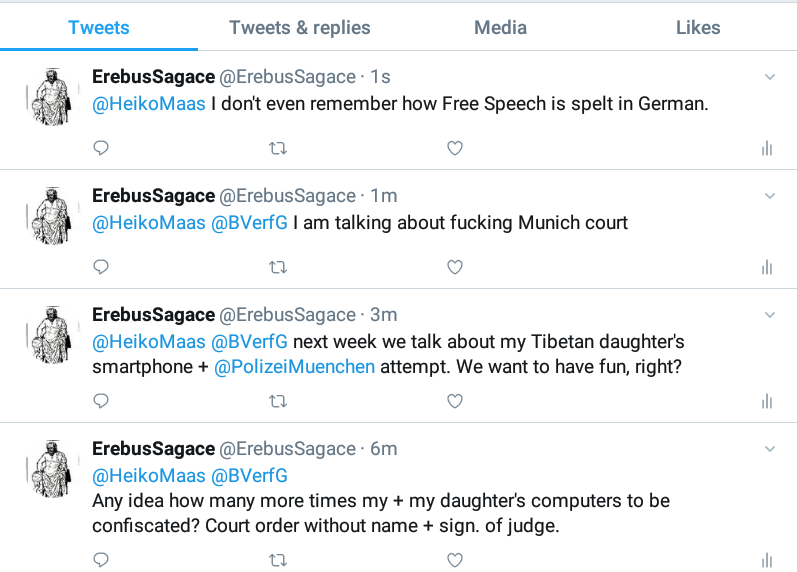
Some tweets with German Justice Minister & Teutonic Antiseptic Internet Guru Heiko Maas

Heiko Maas and German Constitutional Court, any idea how many more times my and my daughter's computers to be confiscated? Court order without name and signature of the judge!

How fucked up is your country, Justice Minister Maas?!

6/09/2017

UN High Commissioner for Human Rights (OHCHR) thinks "Suck my Dick" is great cinema but German Justice Minister Heiko Maas better take a hike

Er, there's spinach between your teeth.
Oh man, where do you start with douchebag 'Fatzke' Heiko Maas, the Justice Minister from Germany? The great cinematic oeuvres of his retreaded muse Natalia, Heiko on his Cervélo, or Heiko and Natty rearranging some furniture worth to the tune of, ooh hold your breath, a pompous € 9,000 in their Westwing, or how about with a mellifluous thing like "Netzwerkdurchsetzungsgesetz"? After all, this is Germany with its word concoctions the length of a freight train. No one knows who invented that name, not even the Heiko himself.

The  Special Rapporteur  on the  promotion and protection of  the  right  to  freedom  of opinion and  expression took a glance at Heiko Maas law and on first reflection thought he was sitting in the lounge of the Amanzi Lodge in Zimbabwe with Robert Mugabe lurking over his shoulder. Relax, it was only the dapper Heiko. Still, that was enough to write his Report. (Pdf download)

REFERENCE: OL DEU  1/2017 

Excellency, 1  June  2017 

I  have  the  honour  to  address  you  in  my  capacity  as  Special  Rapporteur  on  the promotion  and  protection  of  the  right  to  freedom  of  opinion  and  expression,  pursuant  to Human Rights Council  resolution 34/18. 

(He added off the record that he considered​ Natalia to be a pretty hot bitch before he continued in his business.)

In  this  connection,  I  would  like  to  bring  to  the  attention  of  your  Excellency’s Government information I have received concerning the draft law “Netzdurchführungsgesetz”,  presented  by  the  Government  on  14  March  2017,  and expected  to  be  voted  on  in  Parliament  before  the  national  elections  of  September  2017. The  law  raises  serious  concerns  about  freedom  of  expression  and  the  right  to  privacy online.

According  to the  information received: The  Netzdurchführungsgesetz  (hereinafter  “the  bill”)  was  proposed  by  the German  Cabinet  on  14  March  2017.  The  bill  was  introduced  as  a  measure  to protect  network  users  against  hate  speech  and  misinformation  online  by  putting pressure  on  social  media  companies  to  respond  to  user  complaints  and  delete criminal  content  from  their  websites.
  ...

Concerns  at  the  bill’s  over-regulation  of  social  media  has  been  expressed  by  the European  Commissioner  for  the  Single  Digital  Market,  who  has  encouraged  selfregulation.

Before identifying the concerns raised by the bill, I want to note that article 19 of
the International Covenant on Civil and Political Rights (ICCPR), ratified by Germany on 17 December 1973, protects everyone’s right to maintain an opinion without interference and to seek, receive and impart information and ideas of all kinds, regardless of frontiers and through any media. Under article 19(3) of the ICCPR, restrictions on the right to freedom of expression must be “provided by law”, and necessary for “the rights or reputations of others” or “for the protection of national security or of public order (ordre public), or of public health and morals”. Under Article 20, States are obligated to prohibit by law “advocacy of national, racial or religious hatred that constitutes incitement to discrimination, hostility or violence”, but such restrictions must meet the strict conditions of article 19(3) (CCPR/C//GC/34). Permissible restrictions on the internet are the same as those offline (A/HRC/17/27).

Under the article 19(3) requirement of legality, it is not enough that restrictions on
freedom of expression are formally enacted as domestic laws or regulations. Instead, restrictions must also be sufficiently clear, accessible and predictable (CCPR/C/GC/34). The requirement of necessity also implies an assessment of the proportionality of restrictions, with the aim of ensuring that restrictions “target a specific objective and do not unduly intrude upon the rights of targeted persons”. The ensuing interference with third parties’ rights must also be limited and justified in the interest supported by the intrusion (A/HRC/29/32). Finally, the restrictions must be “the least intrusive instrument among those which might achieve the desired result” (CCPR/C/GC/34). The prohibition of advocacy of national, racial or religious hatred that constitutes incitement to discrimination, hostility or violence under article 20(2) of the ICCPR must be read in light of the strict requirements of article 19(3).

In addition, article 17(1) of the ICCPR provides for the rights of individuals to be
protected, inter alia, against unlawful or arbitrary interference with their privacy and correspondence, and provides that everyone has the right to the protection of the law against such interference. “Unlawful” means that no interference may take place except in cases envisaged by the law which in itself must comply with provisions, aims and objectives of the ICCPR. Articles 17 and 19 of the ICCPR are closely connected, as the right to privacy is often understood to be an essential requirement for the realization of the right to freedom of expression (A/RES/68/167, A/HRC/27/37, A/HRC/23/40, A/HRC/29/32).

While it is recognized that business enterprises also have a responsibility to
respect human rights, censorship measures should not be delegated to private entities (A/HRC/17/31). States should not require the private sector to take steps that unnecessarily or disproportionately interfere with freedom of expression, whether through laws, policies or extralegal means (A/HRC/32/38).

The full texts of the human rights instruments and standards outlined above are
available at www.ohchr.org and can be provided upon request. In light of the above standards of international human rights law, I would like to present the following observations and concerns raised by sections 3 and 4 of the bill:

(The Commissioner gives details about the bill ... before he raises his concerns)

Concerns: 

The State has a legitimate interest and responsibility to protect against terrorism,
child pornography, and hate speech that constitutes incitement to discrimination, hostility or violence. The question that arises relates to the way in which the bill seeks to achieve legitimate objectives, in particular the responsibilities it places upon private companies to regulate the exercise of freedom of expression, and whether the measures proposed by the bill would be lawful under international human rights law.

The obligations placed upon private companies to regulate and take down content
raises concern with respect to freedom of expression. A prohibition on the dissemination of information based on vague and ambiguous criteria, such as “insult” or “defamation”, is incompatible with article 19 of the ICCPR. The list of violations is broad, and includes violations that do not demand the same level of protection. Moreover, many of the violations covered by the bill are highly dependent on context, context which platforms are in no position to assess. In addition, the vague definition of “social network” raises questions as to the range of actors covered by the scope of the bill. According to the wording, it would cover all kinds of providers, including messaging services. At the same time, according to the explanatory notes to the bill, the law would not apply to email and messengers.

The provisions imposing high fines for non-compliance with the obligations set
out in the bill raise concerns, as these obligations as mentioned above may represent undue interference with the right to freedom of expression and privacy. The high fines raise proportionality concerns, and may prompt social networks to remove content that may be lawful.

The risk appears even higher considering the strict time periods of 24 hours and 7
days according to which social networks must assess and remove content in violation of domestic law. The short deadlines, coupled with the afore-mentioned severe penalties, could lead social networks to over-regulate expression - in particular, to delete legitimate expression, not susceptible to restriction under human rights law, as a precaution to avoid penalties. Such pre-cautionary censorship, would interfere with the right to seek, receive and impart information of all kinds on the internet.

Further, I am concerned with the lack of judicial oversight with respect to the responsibility placed upon private social networks to remove and delete content. Any legislation restricting the right to freedom of expression and the right to privacy must be applied by a body which is independent of any political, commercial, or unwarranted influences in a manner that is neither arbitrary nor discriminatory (A/HRC/17/27). The liability placed upon private companies to remove third party content absent a judicial oversight is not compatible with international human rights law.

I am also concerned at the provisions that mandate the storage and documentation
of data concerning violative content and user information related to such content, especially since the judiciary can order that data be revealed. This could undermine the right individuals enjoy to anonymous expression (A/HRC/29/32). Such restrictions on anonymity, in particular absent judicial oversight, facilitate State surveillance by simplifying the identification of individuals accessing or disseminating prohibited content. By requiring complaints and measures to be documented and stored for an undisclosed amount of time, without providing further protection mechanisms against the misuse of such data, individuals become more vulnerable to State surveillance. These provisions also allow for the collection and compilation of large amounts of data by the private sector, and place a significant burden and responsibility on corporate actors to protect the privacy and security of such data (A/HRC/23/40).

Finally, I am concerned at the possibility that users claiming a violation would be entitled to be given access to subscriber data without prior court approval. The protection of anonymity, including protection against unlawful and arbitrary interference by state or non-state actors, plays a critical role in securing the right to freedom of opinion and expression. The absence of a judicial warrant for the disclosure of individual information would represent a restriction that is neither targeted nor protecting of due process rights, and it would therefore not meet the strict test required for restrictions on privacy and expression (A/HRC/29/32).

In view of these observations, I would like to call on your Excellency’s
Government to take all steps necessary to conduct a comprehensive review of the bill to ensure its compliance with international human rights law.

As it is my responsibility, under the mandate provided to me by the Human Rights
Council, to seek to clarify all cases brought to my attention, I would be grateful for any additional information and comment you may have on the above.

I would appreciate receiving a response within 60 days. I would like to inform you that this communication will be made available to the public and posted on the website page for the mandate of the Special Rapporteur on the right to freedom of expression: http://www.ohchr.org/EN/Issues/FreedomOpinion/Pages/LegislationAndPolicy.aspx.

Your Excellency’s Government’s response will be made available in a report to be
presented to the Human Rights Council for its consideration. 


Please accept, Excellency, the assurances of my highest consideration.


David Kaye

Special Rapporteur on the promotion and protection of the right to freedom of opinion and expression
. . . (End) . . .

To which I wish to add in the direction of Berlin:


Please accept, Your Dickheadedness, the assurances of the highest commotions in my digestive tract. Relief would most certainly be assured by your buggering off from the palcoscenico.